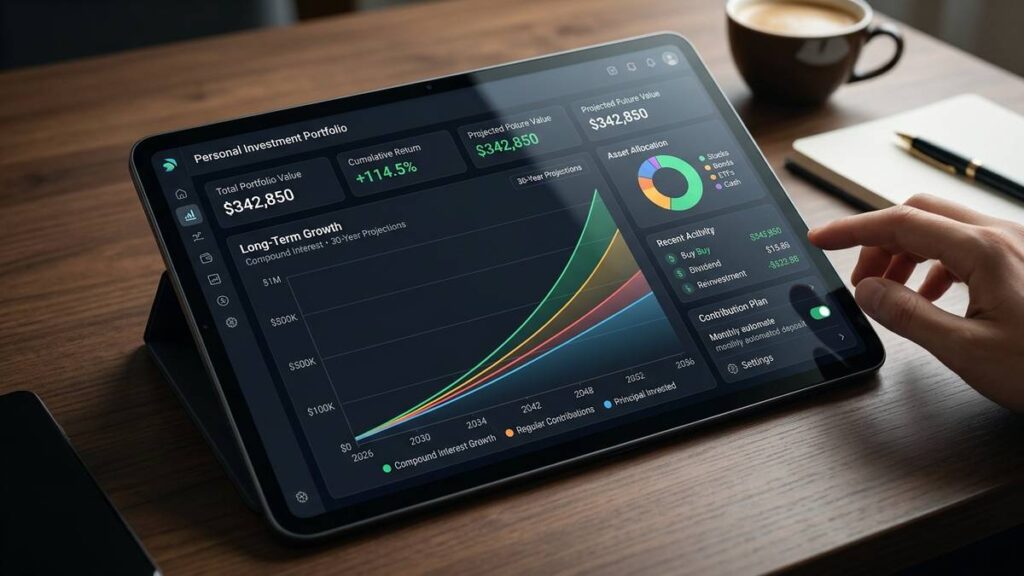
The Paralyzing Fear of the Financial Market
Ask the average adult why they have not started investing for their future, and you will almost always hear the exact same emotional confession:
‘I know I should be investing, but it feels so overwhelming, confusing, and terrifying. What if I make an expensive mistake and lose all my hard-earned savings?’
It is completely understandable why so many intelligent, hardworking people feel paralyzed.
For decades, the traditional financial services industry and Wall Street media have deliberately complicated investing. They fill television screens with frantic shouting, flashing ticker symbols, complex mathematical jargon, options derivatives, and high-frequency trading schemes.
Financial brokers and hedge funds want you to believe that investing is an exclusive, hyper-complex game that requires a degree in quantitative economics and twenty hours a week staring at stock charts, so you feel forced to hand over expensive management fees to ‘experts.’
However, in 2026, the empirical data of modern financial science has thoroughly dismantled that Wall Street myth.
The greatest wealth-building strategy in human history is not picking hot individual stocks, timing market crashes, or trading speculative cryptocurrencies.
The greatest wealth-building strategy on earth is remarkably simple, boring, low-cost, and completely automated.
It is the mechanical art of capturing the long-term compounding growth of the global economy through Broad-Market Index Funds and Dollar-Cost Averaging.
You do not need thousands of dollars to begin. You do not need to read stock charts. You can start with fifty dollars this week.
In this beginner-friendly roadmap, we will demystify the stock market, eliminate financial jargon, and guide you step-by-step through setting up your first automated investment engine.
The Magic of Compound Interest: The Eighth Wonder of the World
Before touching a brokerage account, you must understand the mathematical engine driving all long-term wealth: Compound Interest.
Albert Einstein famously remarked:
‘Compound interest is the eighth wonder of the world. He who understands it, earns it; he who doesn’t, pays it.’
Simple Interest vs. Compounding Exponential Growth:
– Simple Interest: You invest $1,000 at a 10% return. You earn $100 every year linearly.
– Compound Interest: You invest $1,000 at a 10% return.
– Year 1: You earn $100. Your new balance is $1,100.
– Year 2: You earn 10% on $1,100, which is $110. Your balance is $1,210.
– Year 10: Your money is generating over $250 a year without you lifting a finger.
– Year 30: That single $1,000 investment has compounded into $17,449!
The Astonishing Reality of Monthly Compounding:
Consider an everyday individual who commits to investing just $300 a month into a diversified broad-market index fund earning an average historical market return of 8% annually:
– After 10 Years: You have contributed $36,000. Your portfolio balance is $54,883.
– After 20 Years: You have contributed $72,000. Your portfolio balance is $176,706.
– After 30 Years: You have contributed $108,000. Your portfolio balance is $447,107!
– After 40 Years: You have contributed $144,000. Your portfolio balance has compounded into a staggering $1,053,425!
Notice the geometry of wealth: Over $900,000 of that million-dollar fortune was completely free money generated by compound growth! The earlier you start, the less of your own money you have to contribute.
Individual Stocks vs. Index Funds: Why Boring Always Wins
When beginners think about investing, they imagine buying shares of single companies: ‘Should I buy Tesla, Apple, or Amazon?’
The Danger of Individual Stock Picking:
Picking individual stocks is an extraordinarily risky gamble. Companies that seem invincible today can stumble, get disrupted by new technology, or suffer executive fraud (remember Enron, Kodak, Blockbuster, and Sears).
Over any fifteen-year period, over ninety-two percent of professional, full-time Wall Street mutual fund managers Fail to Beat a simple broad-market index fund!
If elite professionals with Bloomberg terminals and Ivy League degrees cannot reliably beat the market, amateur investors picking stocks on their phones are guaranteed to underperform.
The Index Fund Revolution: Buying the Entire Haystack:
Legendary investor John Bogle, founder of Vanguard, pioneered a revolutionary concept:
‘Don’t look for the needle in the haystack. Just buy the haystack!’
An Index Fund (such as an S&P 500 index fund) is a single financial basket that holds fractional ownership in the five hundred largest, most profitable public companies in the United States simultaneously.
– When you buy one share of an S&P 500 index fund, you instantly become a partial owner of Microsoft, Apple, Nvidia, Amazon, Alphabet, Johnson & Johnson, Visa, and hundreds of other global titans.
– If one company fails, it drops out of the index and is automatically replaced by a thriving new company. You participate in the permanent upward drift of human innovation.
The Order of Operations: The Wealth-Building Account Sequence
Where should you put your investment dollars first? Follow this strict four-step financial hierarchy:
Step 1: The Employer 401(k) Match (100% Guaranteed Return)
If your employer offers a 401(k) matching contribution (e.g., matching your contributions dollar-for-dollar up to 4% of your salary), contribute enough to capture the full match immediately.
A match is instant, guaranteed free money. If you put in four dollars and your boss puts in four dollars, you achieved a 100% instant return before the money is even invested!
Step 2: Eliminate High-Interest Consumer Debt
Never invest in the stock market while carrying high-interest credit card debt at twenty-four percent interest. Paying off a 24% credit card is the mathematical equivalent of earning a guaranteed, risk-free 24% return on your money.
Step 3: The Roth IRA (The Tax-Free Wealth Fortress)
A Roth Individual Retirement Account (Roth IRA) is the greatest wealth-building vehicle ever granted to everyday citizens:
– You contribute after-tax money (up to annual statutory limits).
– Your investments compound inside the account completely tax-free for decades.
– When you withdraw your millions in retirement after age 59.5, you pay Zero Dollars in federal and state income taxes!
Step 4: Standard Taxable Brokerage Accounts
Once your tax-advantaged retirement accounts are maxed out, open a standard taxable brokerage account (with low-cost providers like Vanguard, Fidelity, or Charles Schwab) for unlimited investing flexibility.
The Automated Strategy: Dollar-Cost Averaging
How do you know when to buy? Should you wait for a market dip or recession?
The Fatal Mistake of Market Timing:
Amateur investors try to time the market: they hoard cash waiting for a crash, miss the biggest rally days, panic-sell when the market drops, and buy back in when prices are at all-time highs.
Legendary investor Peter Lynch observed:
‘Far more money has been lost by investors preparing for corrections, or trying to anticipate corrections, than has been lost in corrections themselves.’
The Mechanical Solution: Dollar-Cost Averaging (DCA):
Dollar-Cost Averaging means investing the exact same fixed dollar amount (e.g., $200 every Friday or on the 1st of every month), regardless of what the stock market is doing.
– When market prices are high, your fixed dollars buy fewer shares.
– When market prices crash, your fixed dollars automatically buy significantly more shares on sale!
Over decades, DCA eliminates emotional stress and guarantees you achieve an exceptional average share price.
Conclusion: The Single Most Important Day to Start
The best time to plant an oak tree was twenty years ago. The second best time is today.
The exact same truth applies to your financial future.
You do not need to wait until you have a six-figure salary. You do not need to wait until you understand every line of financial code.
Open a low-cost brokerage account this weekend, set up an automated transfer of fifty or one hundred dollars a month into a total market index fund, turn on automated dividend reinvestment, and let the magnificent power of compound interest work for your family.
Your future self will look back on today with immense, lifelong gratitude.
Understanding Asset Allocation: Balancing Stocks and Fixed Income
While broad-market stock index funds drive the powerful engine of long-term wealth accumulation, intelligent investing requires balancing risk and volatility through Strategic Asset Allocation.
The Two Core Asset Classes:
- Equities (Stocks): Growth assets that represent partial ownership in companies. Stocks provide high historical returns (average 8-10% annually over long horizons), but experience significant short-term volatility.
- Fixed Income (Bonds / Treasuries): Capital preservation assets that loan money to governments or stable corporations in exchange for regular interest payments. Bonds provide portfolio stability, dampening stock market swings.
The Age-Appropriate Allocation Rule:
– In Your 20s and 30s: You have decades to ride out market dips. Maintain an aggressive, growth-oriented allocation (e.g., 90% Equities / 10% Fixed Income).
– In Your 50s and 60s: As retirement approaches, gradually shift capital into capital preservation (e.g., 60% Equities / 40% Fixed Income) to protect your nest egg from sequence-of-returns risk.
The Psychology of Market Crashes: How to Stay Disciplined When Stocks Drop
The true test of an investor is not how they act when the market is setting all-time highs; it is how they respond when financial headlines scream that the world is ending and portfolio values drop thirty percent in a month.
The Biological Panic Reflex:
When market volatility strikes, your brain’s evolutionary threat center (the amygdala) urges you to flee: ‘Sell everything and move to cash before you lose it all!’
This biological urge is financial suicide. Selling during a market crash locks in temporary paper losses and guarantees you will miss the subsequent explosive market recovery.
The Golden Rules of Market Turbulence:
– Recognize Crashes as Generational Sales: When the stock market drops thirty percent, the greatest companies on earth are trading at a massive discount. Keep your automatic investments running.
– Turn Off Financial News: Financial news media generates advertising revenue through panic and sensationalism. Close your banking app, step away from screens, and let compound interest do its long-term work in peace.
The Role of Low-Cost Automated Robo-Advisors
If picking index funds yourself still feels intimidating, modern fintech offers an exceptional automated middle ground: Robo-Advisors.
Platforms like Betterment, Wealthfront, and Vanguard Digital Advisor utilize Nobel Prize-winning Modern Portfolio Theory algorithms to build and rebalance diversified global portfolios automatically:
– Automated Dividend Reinvestment: Dividends are automatically swept back into purchasing fractional shares.
– Tax-Loss Harvesting: In taxable accounts, algorithms automatically harvest capital losses to offset taxable gains, boosting after-tax returns with zero manual effort.
Robo-advisors charge tiny fees (typically 0.25% annually), providing world-class professional asset management for the price of a cup of coffee.