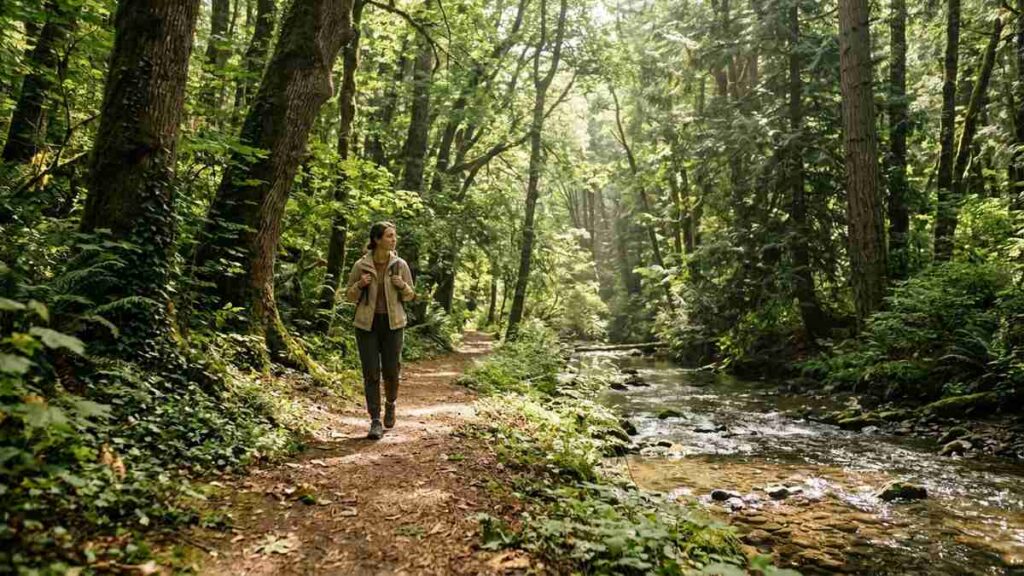
The Domesticated Human: An Ecological Mismatch
If you examine the daily physical environment of the average human being in 2026, you will witness a staggering evolutionary disconnect.
For ninety-nine point nine percent of human history, our species lived, worked, slept, and navigated entirely within the natural world. Our sensory biology, circadian hormonal clocks, autonomic nervous systems, and immune pathways were meticulously sculpted over hundreds of thousands of years to operate in direct communion with sunlight, soil, wind, running water, and living forests.
Yet, in a single blink of evolutionary time, we have completely domesticated ourselves.
According to major environmental health studies, the average modern adult now spends an astonishing ninety-three percent of their entire life indoors: living inside drywalled apartments, commuting inside climate-controlled metal vehicles, and working inside fluorescent-lit commercial offices staring at blue-light glass screens.
We have isolated ourselves from the very habitat that created us.
The biological consequences of this ecological divorce are catastrophic: epidemic levels of chronic anxiety, sleep disorders, clinical depression, myopia, autoimmune inflammation, and profound spiritual fatigue. Author Richard Louv famously coined the term ‘Nature Deficit Disorder’ to describe the deep physiological and psychological trauma caused by our modern indoor existence.
Fortunately, the medicine required to reverse this biological collapse is not an expensive pharmaceutical prescription or a complex wellness gadget.
It is free, universally accessible, and sitting directly outside your front door: The Simple Act of Getting Outside Every Day.
In this comprehensive investigation, we explore the cutting-edge scientific evidence, biological mechanisms, and daily practical habits that prove spending time in nature is one of the most powerful, life-saving investments you can make in your health.
Circadian Realignment: Morning Photons and Sleep Architecture
The single most impactful biological benefit of stepping outdoors occurs within the first sixty minutes of waking up: the calibration of your Circadian Rhythm through natural solar photons.
Inside a modern home or office, artificial indoor lighting typically emits between one hundred and five hundred Lux (the standard measurement of light illuminance). Even though indoor lighting feels bright to your eyes, to the specialized photopigments in your retina, indoor rooms are effectively pitch black.
Step outside onto an overcast morning, however, and the ambient natural sunlight delivers over ten thousand to twenty-five thousand Lux. On a clear sunny morning, that number surges past fifty thousand to one hundred thousand Lux!
The Retinal-Hypothalamic Clock:
When high-lux solar photons enter your eyes, they strike specialized cells called intrinsically photosensitive retinal ganglion cells (ipRGCs). These cells do not produce conscious vision; they send an immediate electrical signal to the suprachiasmatic nucleus (SCN), the master biological master clock inside your hypothalamus.
This solar signal coordinates two miraculous hormonal events:
- The Morning Cortisol Awakening Response: It triggers a healthy, natural pulse of cortisol and dopamine that clears sleep inertia, boosts cognitive alertness, and sharpens mental focus for the day.
- The Melatonin Countdown Timer: It sets an internal biological countdown timer for Melatonin production. Exactly twelve to fourteen hours after your eyes perceive morning outdoor photons, your pineal gland releases melatonin, allowing you to fall asleep smoothly, enjoy deep restorative delta-wave sleep, and wake up refreshed without sleep medications.
Phytoncides and NK Cells: Nature’s Organic Immune Booster
In Japan, the practice of spending mindful time in natural woodlands is considered legitimate preventive medicine, known nationally as ‘Shinrin-yoku’ (Forest Bathing).
In landmark clinical research conducted at Nippon Medical School in Tokyo, Dr. Qing Li and his team investigated why walking through natural forests produces measurable physiological healing that walking through urban city streets cannot match.
The answer lies in microscopic organic chemical compounds known as Phytoncides.
Phytoncides are natural antimicrobial volatile organic compounds (including alpha-pinene, carene, and d-limonene) that trees and plants release into the air to protect themselves from fungal decay, bacterial infections, and insect pests.
When you walk through a pine forest, oak woodland, or green garden, you inhale these airborne phytoncides deep into your lungs.
The Cellular Immune Response:
Clinical blood tests revealed that inhaling forest phytoncides triggers a dramatic, prolonged surge in the activity and count of Natural Killer (NK) Cells in the human bloodstream.
– Natural Killer cells are elite immune lymphocytes that seek out and destroy virus-infected cells and early-stage cancerous cells.
– A single two-hour walk in a natural forest increased participants’ circulating NK cell activity by over fifty percent, and that immune enhancement persisted in their bloodstreams for more than thirty consecutive days!
Stepping into nature is not merely a pleasant aesthetic hobby; it is a direct biological vaccination for your immune system.
Downregulating the Amygdala: The Antidote to Urban Stress
Modern urban and digital environments demand what environmental psychologists call ‘Directed Attention.’ You must constantly force your brain to filter out traffic sirens, flashing advertisements, email banners, and text alerts. This relentless, active filtering exhausts the prefrontal cortex, leading to cognitive fatigue, mental burnout, and emotional volatility.
Nature, in stark contrast, engages what is known as ‘Soft Fascination.’
When you watch the rhythmic ripples of sunlight dancing across running river water, observe autumn leaves fluttering in the wind, or gaze at clouds drifting across a mountain ridge, your brain experiences gentle, effortless attention.
Soft fascination allows the prefrontal cortex to completely power down and restore its neurochemical reserves.
Neuroimaging Evidence of Stress Relief:
Neuroscience research utilizing functional MRI (fMRI) scans demonstrates that spending just twenty minutes in green natural spaces causes an immediate, dramatic drop in blood flow to the Amygdala (the brain’s threat and anxiety center). Salivary cortisol levels plummet, resting heart rate slows, and heart rate variability (HRV) shifts toward deep parasympathetic relaxation.
Nature literally recalibrates your nervous system from chronic panic into restorative peace.
Biophilia and Fractal Geometry: The Eye-Brain Resonance
Renowned evolutionary biologist E.O. Wilson proposed the ‘Biophilia Hypothesis’, asserting that humans possess an innate, genetically encoded affinity for the living natural world.
Our sensory perceptual systems evolved to process the specific mathematical patterns of natural ecosystems.
In physics and mathematics, nature is constructed out of Self-Similar Fractal Geometries: repeating mathematical patterns across scales found in tree branching structures, fern fronds, river networks, snowflakes, and ocean waves.
Fractals and Alpha Brain Waves:
When the human eye gazes at natural statistical fractals (specifically fractals with a mid-range dimensional scale between 1.3 and 1.5), your visual cortex processes the geometry with extraordinary metabolic ease.
– Quantitative electroencephalogram (EEG) recordings show that viewing natural fractal patterns instantly stimulates the production of Alpha Brain Waves (the brainwave frequency associated with relaxed, creative alertness and meditative calm).
– Conversely, staring at the sterile, ninety-degree linear boxes of modern cubicles, concrete parking garages, and grid-like digital spreadsheets forces the brain into stressful, high-beta wave activity.
Your brain was designed to look at trees, clouds, and water. When you deny it those patterns, your psychology suffers. When you return to nature, your brain sighs with immense visual relief.
Microbiome Diversity and the ‘Old Friends’ Hypothesis
Another extraordinary benefit of outdoor exposure is the enrichment of your Internal Cellular Microbiome.
The ‘Old Friends’ Hypothesis in immunology suggests that modern allergic, autoimmune, and inflammatory diseases stem from our overly sanitized indoor environments. We wash with antibacterial soaps, live in sealed buildings, and rarely touch living dirt, starving our immune systems of beneficial environmental microorganisms.
When you walk outdoors, dig in the garden soil, breathe forest air, and touch tree bark, you expose your skin and respiratory tract to millions of diverse, beneficial soil-based organisms, including Mycobacterium vaccae.
Groundbreaking research from the University of Colorado demonstrated that exposure to Mycobacterium vaccae stimulates the release of serotonin in the brain, functioning like a natural antidepressant while training human regulatory T-cells to prevent excessive systemic inflammation.
Getting your hands dirty in the natural world is biological medicine for your gut, your skin, and your mind.
The 20-5-3 Rule: A Sustainable Blueprint for Daily Nature Integration
You do not need to pack up your life and live in a remote wilderness yurt to reap the miraculous benefits of outdoor living.
Dr. Rachel Hopman and neuroscientists recommend the simple, scalable 20-5-3 Nature Pyramid:
Level 1: 20 Minutes a Day (The Daily Reset)
Spend twenty minutes outside in a local neighborhood park, a tree-lined street, or your own backyard every single day. Leave your phone inside. Notice the clouds, feel the wind on your face, and let the natural light wash over your eyes. This twenty-minute investment flattens daily cortisol curves and ensures restful nighttime sleep.
Level 2: 5 Hours a Month (The Semi-Wild Immersion)
Dedicate five hours each month to immersing yourself in a semi-wild regional park, nature reserve, botanical garden, or state forest. Go for an unhurried hike, sit beside a creek, or enjoy an outdoor picnic. This deeper exposure supercharges your Natural Killer immune cells and restores cognitive creativity.
Level 3: 3 Days a Year (The Total Off-Grid Wilderness Rewilding)
Spend three consecutive days camping, backpacking, or retreating in true backcountry wilderness with zero cellular connectivity. Psychologists call this the ‘Three-Day Effect’: by the third day immersed in nature, your brainwaves fully synchronize with natural circadian cycles, anxiety evaporates, and creative problem-solving surges by over fifty percent.
Nature is not a luxury; it is a biological necessity. Reclaim your birthright as a wild, living creature. Step outside, take a deep breath of fresh air, and let the healing power of the earth restore your health, your mind, and your soul.
Visual Health and Myopia Prevention: The 20-20-20 Rule in Nature
Beyond systemic stress reduction and immune enhancement, getting outside every day is essential for protecting modern human vision and optical health.
In our screen-dominated society, human eyes spend ten to twelve hours a day locked in extreme near-field focus, staring at screens positioned eighteen inches from our faces. This persistent near-work places immense mechanical strain on the ciliary muscles of the eye, driving an unprecedented global epidemic of adult myopia (nearsightedness), dry eye syndrome, and severe digital eye strain.
When you step outdoors, your optical mechanics undergo an immediate, restorative shift:
– Far-Field Gaze Expansion: In nature, your eyes are free to gaze at distant horizons, mountain ridges, and high tree canopies, allowing your ciliary muscles to fully relax and release chronic spasm.
– Full-Spectrum Natural Illumination: Natural outdoor daylight provides the full balanced spectrum of light wavelengths (including near-infrared and ultraviolet light) required to stimulate dopamine release in the retina, preventing the abnormal axial elongation of the eyeball that causes nearsightedness.
– Natural Blink Rates and Tear Film Restoration: Staring at digital screens suppresses your natural blink rate by over sixty percent, causing your tear film to evaporate. The fresh outdoor air and natural viewing angles restore normal blinking frequency, soothing irritated eyes and preserving visual acuity.
Make getting outside a non-negotiable optical medicine. Give your eyes the expansive horizons, vibrant natural colors, and gentle sunlight they were designed to behold.