

The Intimidation of the Starting Line
There is a deeply vulnerable, uncomfortable moment that millions of adults experience when they contemplate getting back into physical shape after years of sedentary living.
You open your closet, look at a pair of athletic sneakers that have been gathering dust on the top shelf for five years, and remember the days when you felt light, energetic, and agile.
Then, you look at your current reality. Your lower back aches when you stand at the kitchen counter for twenty minutes, climbing two flights of stairs leaves your heart pounding and lungs burning, and carrying a basket of laundry up from the basement causes your knees to crackle and complain.
Overwhelmed by how far you have slipped, you look online for workout guidance. What do you find? Fitness influencers screaming about ‘No Days Off,’ sixty-minute high-intensity interval training bootcamps, and twenty-year-old athletes performing acrobatic barbell lifts.
Feeling intimidated, self-conscious, and thoroughly defeated before you even begin, you think: ‘I am too old, too out of shape, and too busy. Fitness is for other people.’
That conclusion is completely wrong.
You do not need to punish yourself in a noisy commercial gym to reclaim your health. You do not need to run five miles, flip giant tractor tires, or lift heavy weights until you collapse.
In fact, attempting to jump into aggressive workout regimens after years of inactivity is the single worst mistake you can make; it causes extreme muscle soreness, tendonitis, and joint injury, leading to immediate demoralization and abandonment within ten days.
Your body is a remarkably adaptable biological organism. It does not demand perfection; it simply responds to gentle, consistent, progressive physical signals.
In this compassionate, instructional fitness guide, we will break down the physiology of detraining, explain why starting ridiculously small is your greatest superpower, and provide a progressive eight-week re-entry roadmap designed specifically for adults who have not exercised in years.
The Biology of De-Conditioning (What Actually Happened to Your Body)
To rebuild your physical fitness safely, you must understand what happens to human physiology during extended periods of sedentary living.
First, Cardiovascular Capillarization Loss: When you sit for years, your body conserves energy by pruning micro-capillaries that deliver oxygen-rich blood to skeletal muscles. Your heart stroke volume decreases slightly, meaning your heart must beat faster to circulate blood during modest exertion.
Second, Muscle Atrophy and Synovial Fluid Depletion: Inactive muscle fibers shrink in diameter, and your joints produce less synovial lubricating fluid. Cartilage becomes stiff and dry like a dehydrated kitchen sponge, causing that familiar creaky sensation when you move.
Third, Neural Inefficiency: Your brain motor cortex temporarily forgets how to fire complex muscle recruitment patterns efficiently, making basic movements feel clumsy and taxing.
The Good News: Human muscle and cardiovascular tissue possess profound **biological muscle memory**. When you introduce gentle, regular movement, capillary beds regrow within weeks, synovial fluid begins circulating through joint cartilage, and dormant neural pathways reactivate with astonishing speed.
The Golden Rule: The Minimum Effective Dose
When returning to fitness after years away, throw away the toxic slogan ‘No Pain, No Gain.’
Your guiding operational principle must be **The Minimum Effective Dose (MED)**: What is the smallest, easiest, least painful physical stimulus that will trigger a positive biological adaptation?
If you do a workout that leaves you unable to walk down stairs for four days, that is not a successful workout; that is poor programming. A successful re-entry workout leaves you feeling invigorated, energized, and capable of exercising again tomorrow.
Success in fitness is not determined by how much you can suffer in a single workout. Success is determined by your ability to show up three to four times a week for the next three years.
Phase 1 (Weeks 1 to 3): The Foundation of Brisk Walking
Do not touch a weight, join a gym, or put on a fitness watch during your first three weeks. Your sole assignment is to reawaken your cardiovascular system through the most fundamental human movement: **brisk walking**.
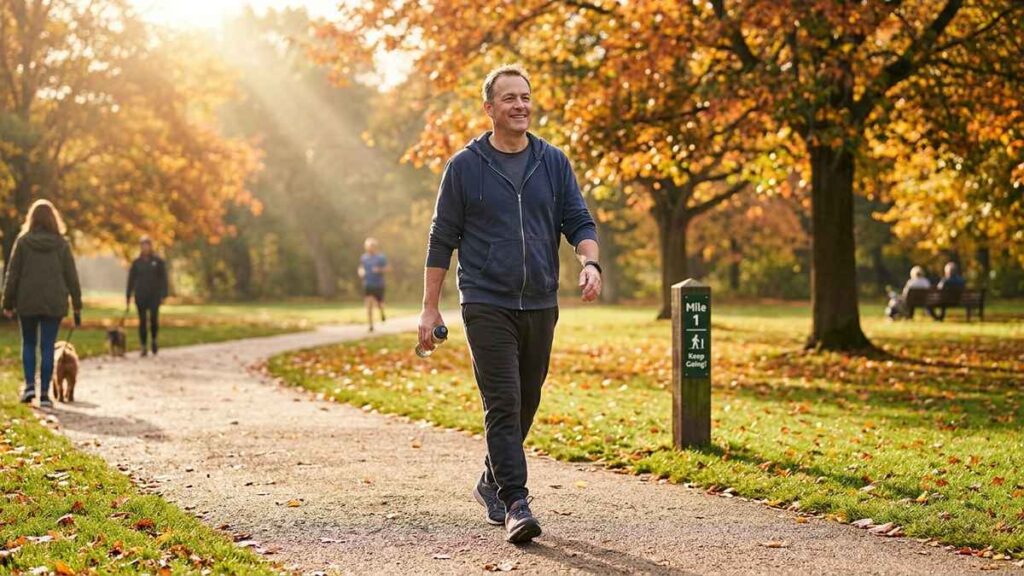
Commit to a simple **15-Minute Daily Walk**. Put on comfortable shoes, step out your front door, walk in one direction for seven and a half minutes, turn around, and walk home.
Keep the pace brisk enough that your breathing elevates, but conversational enough that you could speak a full sentence without gasping.
Walking is completely non-intimidating, costs zero dollars, puts zero compressive impact on knees and spinal discs, and immediately begins regenerating cardiovascular capillary networks while mobilizing deep abdominal visceral fat.
Phase 2 (Weeks 4 to 6): Gentle Bodyweight Mobility and Posture
Once your daily fifteen-minute walk feels effortless, introduce basic joint mobility and bodyweight strength exercises twice a week on your living room rug:
- Box Squats (10 reps): Stand in front of a sturdy dining chair or sofa. Push your hips back and sit down gently until your thighs touch the cushion, pause for one second, and press through your heels to stand tall. This rebuilds fundamental leg strength and hip stability without risking falls.
- Wall Push-Ups (10 reps): Stand two feet away from a wall, place your hands flat at shoulder height, bend your elbows until your nose nearly touches the drywall, and press back. This strengthens chest, shoulder, and core stabilizers with zero wrist strain.
- Glute Bridges (10 reps): Lie on your back with knees bent, squeeze your glutes, and lift your hips toward the ceiling. Sitting all day causes ‘gluteal amnesia’; bridges wake up your primary postural stabilizers, immediately relieving chronic lower back pain.
- Standing Calf Raises (15 reps): Rise up onto your tiptoes and lower slowly. Calves act as secondary muscular pumps that circulate venous blood from your lower legs back to your heart.
Phase 3 (Weeks 7 to 8): Progressive Resistance Training
In weeks seven and eight, incorporate light external resistance. Purchase an inexpensive set of resistance bands or two light dumbbells (five to eight pounds).
Perform basic functional movements: band-assisted chest presses, seated dumbbell rows, and farmer’s walks (carrying a moderate weight in each hand for sixty seconds).
Resistance training is essential for adults over forty because it halts age-related sarcopenia (muscle loss), stimulates bone mineral density to prevent osteoporosis, and increases resting metabolic rate so your body burns more calories all day long.
Biological Recovery, Habit Consistency, and Community Accountability
A critical psychological barrier to overcome when returning to exercise after years away is the destructive habit of comparing yourself to your younger self.
When a forty-five-year-old adult tries to replicate the exact workout routine they performed at nineteen, their connective tissue rebels. Your tendons, ligaments, and hormonal recovery curves have changed over two decades.
Honor where you are today. The goal is not to prove that you can lift what you lifted in college; the goal is to build a body that feels energetic, pain-free, and capable of playing with your children, hiking mountain trails, and enjoying vibrant longevity for the next forty years.
Furthermore, prioritize recovery with the same seriousness you bring to movement. Get eight hours of sleep, hydrate consistently, and eat sufficient dietary protein to support cellular muscle repair. When you respect your body’s need for restorative downtime, progress feels natural and sustainable.
To maintain your exercise routine through busy, stressful weeks, implement the ‘Never Miss Twice’ habit rule. If life derails your Tuesday workout, treat Wednesday’s fifteen-minute session as non-negotiable. Building consistency is the true foundation of lifelong vitality.
Equally vital is finding a supportive fitness community or accountability partner who encourages your progress without judgment. Whether that is walking every morning with a neighbor or joining a community recreational group, sharing your physical journey makes movement joyful and consistent.
Building Sustainable Joint Mobility and Functional Strength
As you progress on your fitness journey, remember that true athletic vitality is measured by how smoothly and effortlessly your body moves through daily life.
Incorporate five minutes of gentle spinal mobility and hip opening stretches before bedtime. Taking care of your connective tissue prevents morning stiffness, improves circulation, and keeps your posture tall and confident.
Celebrate the profound feeling of physical capability: lifting groceries without hesitation, bounding up a flight of stairs with ease, and moving through the world with energy and joy.
Trust in the resilience of your body. When you show up with patience and gentle dedication, your physical vitality will reward you with boundless energy and strength for decades to come.
Nutrition and Hydration Foundations for Everyday Movement
Physical fitness is inextricably tied to how you nourish and hydrate your body on a daily basis.
You do not need complicated diets or expensive supplements. Focus on simple, foundational habits: drink a tall glass of water first thing in the morning, incorporate a palm-sized portion of protein into each meal to support muscle recovery, and fill half your plate with colorful vegetables.
When you provide your body with clean, nutrient-dense fuel and proper hydration, your energy levels soar, joint inflammation subsides, and physical exercise feels like an energizing pleasure rather than an uphill struggle.
Conclusion: Celebrating the Journey Back to Vitality
You do not need to turn back the clock to your high school athletic days to feel strong, capable, and vibrant in your body right now.
Give yourself permission to be a beginner. Celebrate the fact that you walked for fifteen minutes today. Take pride in every box squat, every stretch, and every healthy choice.
Your future self is waiting for you on the other side of consistency. Put on your shoes, step out the door, and begin your joyful journey back to lifelong physical vitality.